
Share this article:
“I was born an artist. Afterwards, I had to explain to everyone just what that meant.”
Marisol
Where the wood becomes memory, silence becomes language, and the ordinary becomes spellbinding or uncanny.
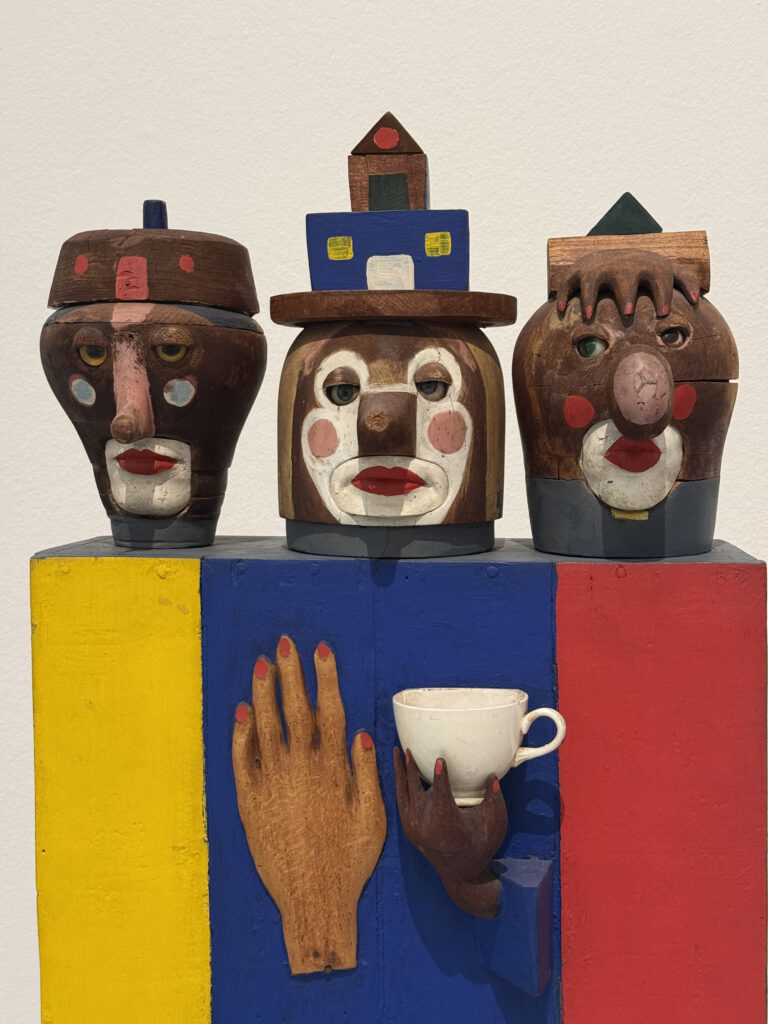
Marisol’s magic is stranger, quieter, and ultimately profound. In her sculptures- often being with remarkably simple materials: wood, paint, clothing, found objects- almost everything appears to possess a life. They became people.
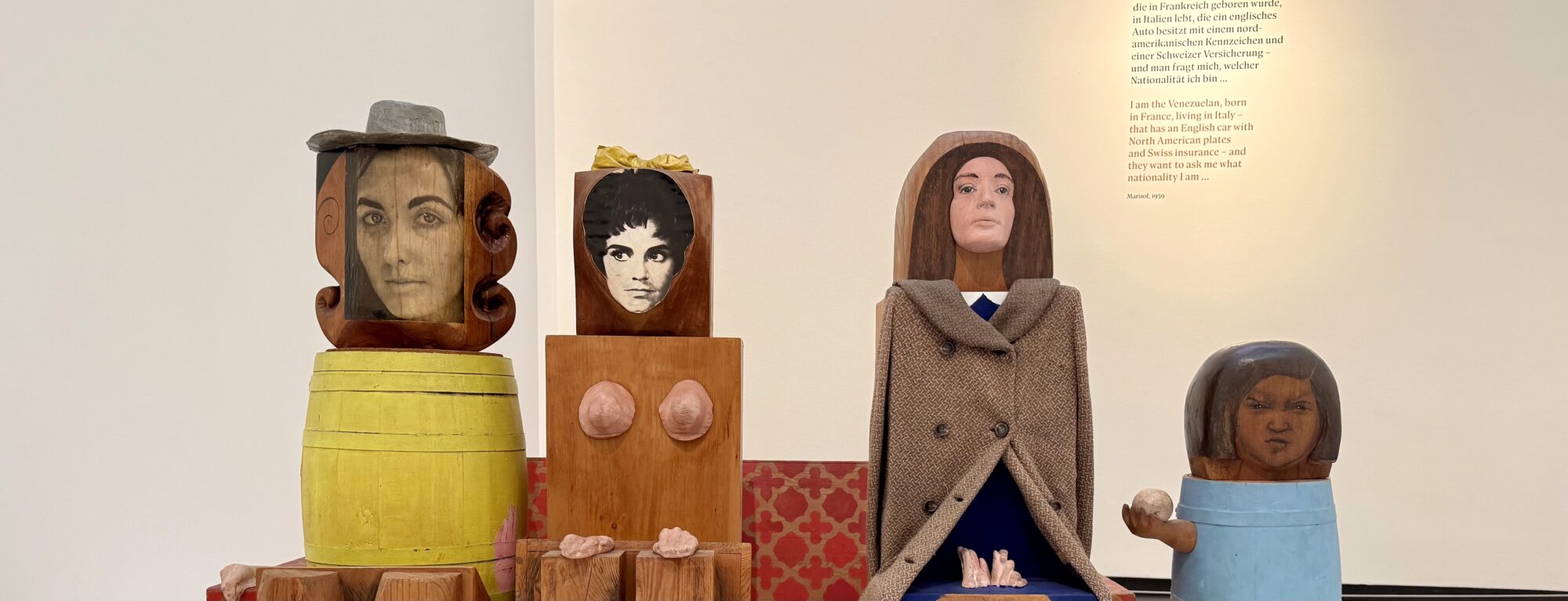
A wooden body sits upright. A painted face looks towards us. A pair of eyes appears to follow our movement through the gallery. We know perfectly the figure is not alive, and yet, psychologically, we respond to it as if it were.
This is the territory of the uncanny- the moment when something familiar becomes subtly strange. Marisol understood this instinctively.
Her figures look like us, but they are not quite us, they resemble portraits, but they are also caricatures. The resemble dolls, but they are monumental.
They seem frozen, yet somehow expect us to imagine what happened before- and what might happen next.
Another source of Marisol’s magic is her refusal of perfection.
The wood remains wood.
Its grain is very visible. Its irregularities are not completely concealed. The carved surfaces sometimes look rough, almost primitive.
Marisol does not try to disguise the material and make it imitate flesh perfectly. She allows us to see the person and the object. The viewer is constantly moving between two perceptions: I am looking at an object, and I am looking at someone.
The magic occurs in the space between those two statements.
A THEATHRE WITHOUT DIALOGUE
Born Maria Sol Escobar in Paris in 1930, to Venezuelan parents, the artist grew up between Venezuela, Europe, and United States.”My only home is in art history,” she said. Her transnational upbringing is significant because Marisol’s later practice consistently resists a singular cultural identity.
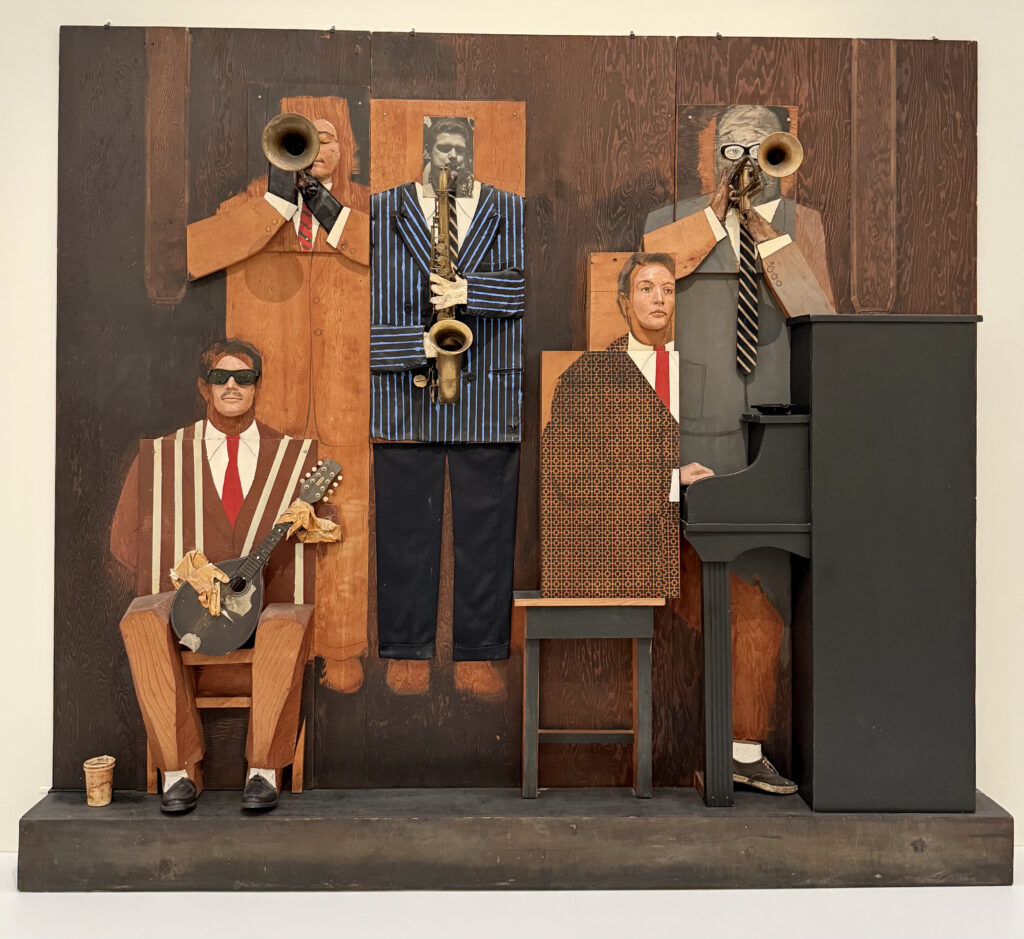
Marisol’s childhood was marked by the devastating loss of her mother, Josefina. Following her mother’s death, when she was 11, she withdrew deeply into silence. Later she described her refusal to speak as a desire not to “sound the way other people did.” It would be simplistic to claim that her sculptures are merely expressions of this trauma. Her work is much more intellectually complex. Their silence is not emptiness, it’s a language.
As a teenager she adopted the name Marisol, a combination of her names and the Spanish words for “sea” and “sun” as her mother called her.
Her early artistic education included study at the Art Students League in New York and with Hans Hofmann. Although she initially pursued painting, she increasingly rejected the two-dimensional picture in favor of sculpture. By the mid-1950s, carved wood had become central to her practice.
Soon after she began incorporating herself into her work through photographs, drawings and casting parts of her body in plaster. “People say they pinch themselves to see if they are awake.” she said.
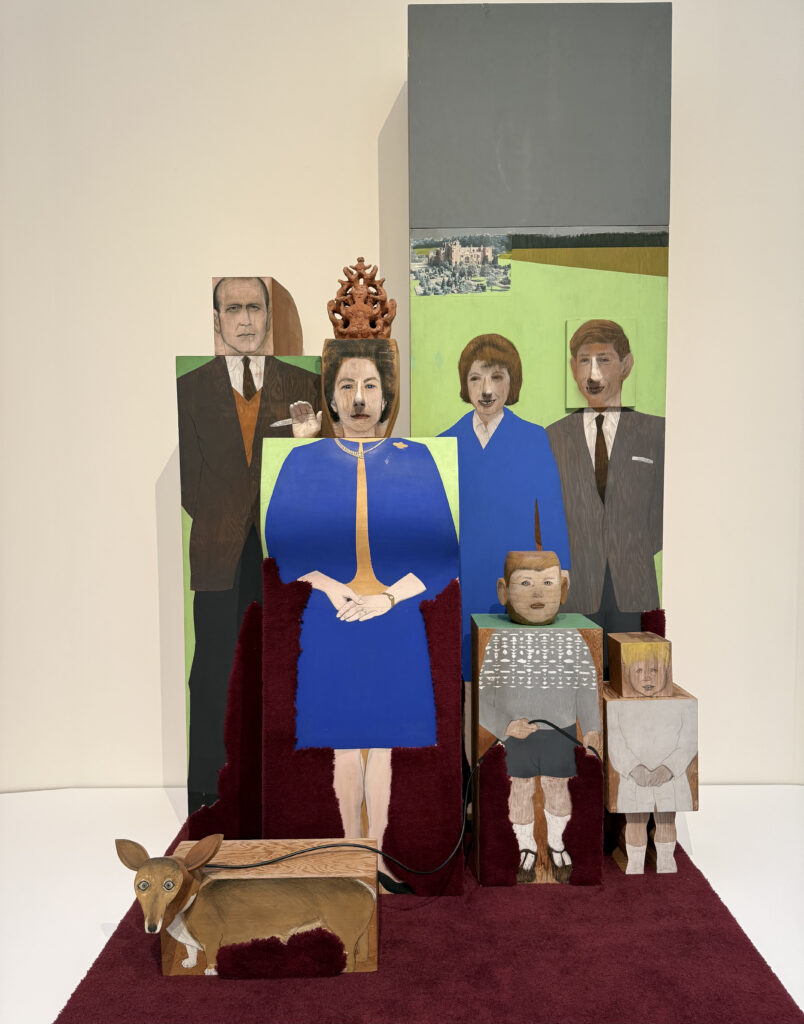
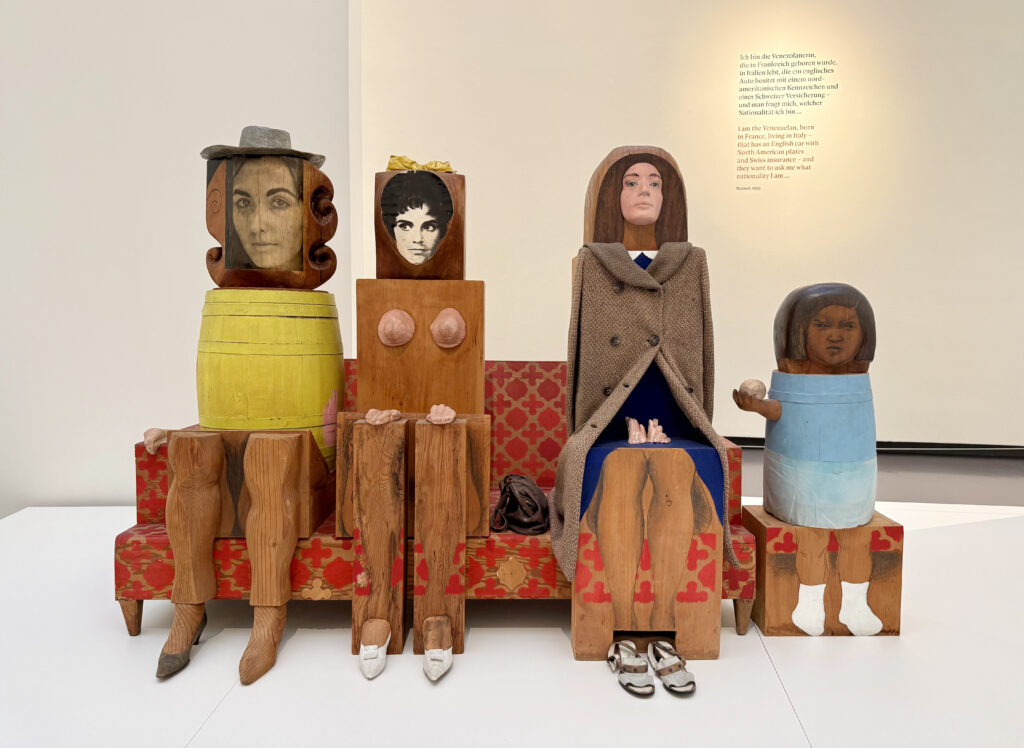
Marisol’s sculptures also possess an unmistakable theatrical quality. Her figures seem to be actors who have been frozen in the middle of a performance. They sit around the tables, they stand beside one another, they pose for photographs, they look towards the viewer, but there is almost never any dialogue. The silence is fundamental.
The exhibition on view at Kunshaus Zurich until 23 August 2026, provides an important opportunity to reconsider Marisol not merely as a peripheral figure within the history of American Pop Art, but as an artist whose practice developed across several competing traditions: pre-Colombian sculpture, European avant-garde practices, American Pop, assemblage, portraiture, and performance. Her position within these histories is precisely what makes her difficult to categories, and perhaps, what contributed to her subsequent marginalization.
The wooden figure allowed Marisol to collapse distinction between sculpture and portrait, object and body, representation, and performance. Her sculptures do not simply depict human beings; they construct them as social and cultural objects.
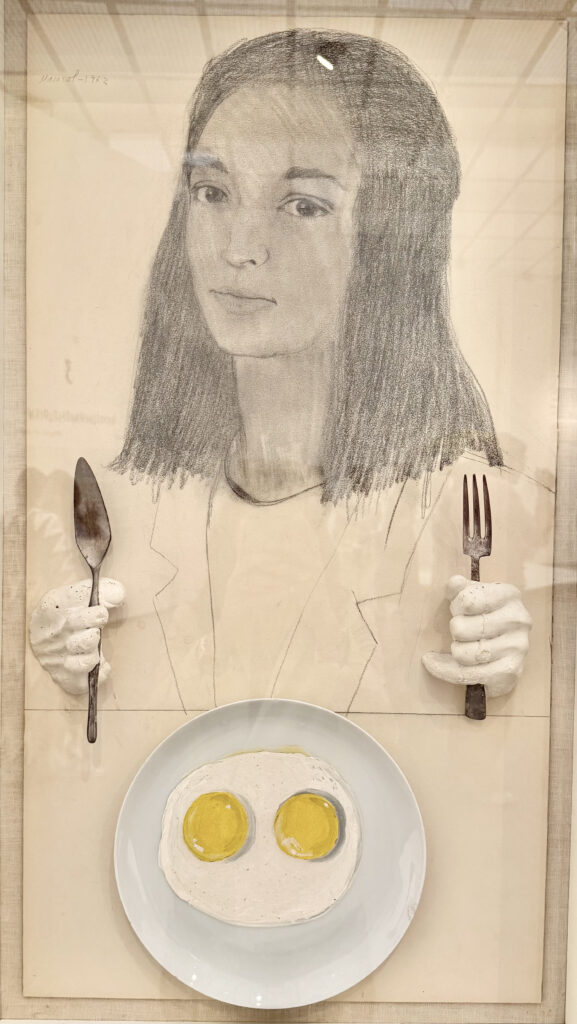
Marisol’s sculptures are overwhelmingly corporeal yet linguistically silent. Her figures communicate trough posture, gaze, facial expression, and spatial arrangement. In this sense, the body becomes a substitute for verbal discourse.
She transforms the inability or refusal to speak into a sophisticated visual language.
Marisol represented Venezuela at the Venice Biennale, in 1968 at the height of her international recognition. Yet shortly afterwards she withdrew significantly from the New York art scene and travelled extensively.
This withdrawal is one of the most intriguing aspects of her biography.
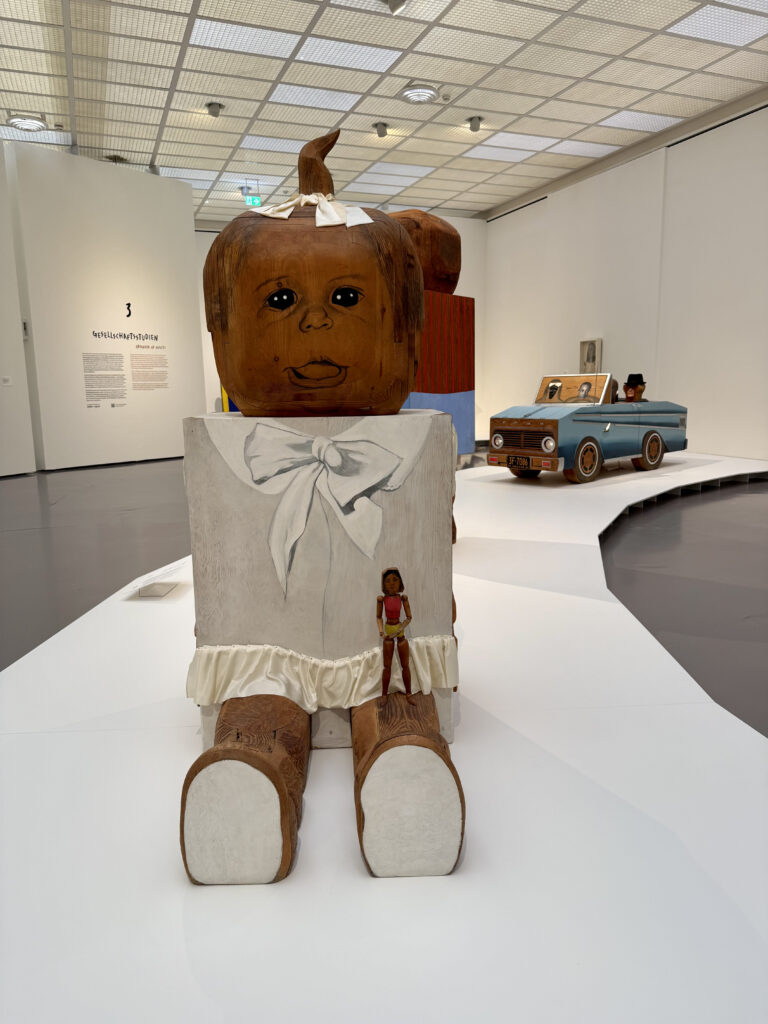
Her disappearance from the art scene coincided with a broader transformation in the critical reception of her work. Marisol did not fit comfortably into any of the dominant narratives. She was associated with Pop but did not embrace its logic completely. She made figurative sculpture at a moment increasingly defined by abstraction and minimalism.
She incorporated feminist concerns without becoming reducible to feminist art.
She used humor without being merely satirical. Her work remained resolutely individual.
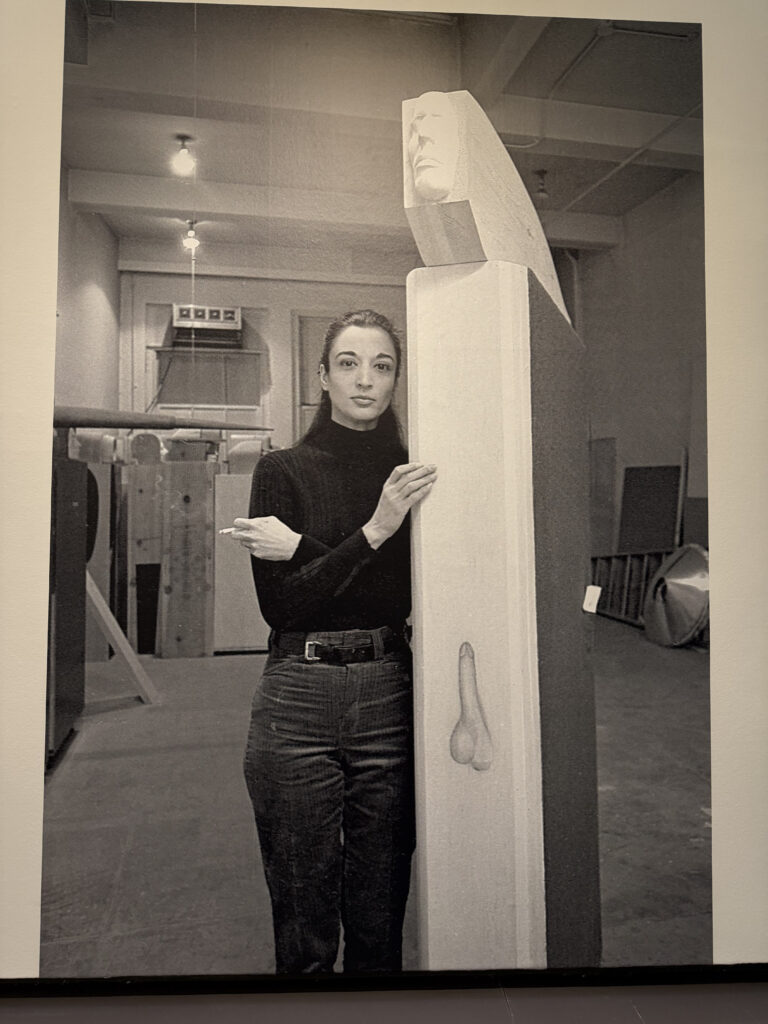
A DELIBERATELY PRIVATE WOMAN
What makes her personal story particularly fascinating is that her solitude was not simply a biographical circumstance- it became part of her artistic language.
During the 1960s she became extremely visible in New York art scene. She was beautiful, elegant, and mysterious. She was close to Andy Warhol, who made films of her and whose artistic trajectory intersected with her.
Yet she refused the conventional role expected of the successful woman of her generation.
She did not marry. She did not have children. And press became fascinated by her romantic life she often answered the intrusion through her art.
One of the most revealing works is “The Wedding” (1962-1963) Marisol represents both bride and groom herself. Similarly, in “Dinner Date” (1963), she appears twice at the same table, as though she is simultaneously the woman waiting for another person and the person she is waiting for.
That is the extraordinary psychologically.
Rather than saying “I don’t need another person,” she creates a visual world in which she becomes both people.
After the extraordinary visibility she achieved in New York during the 1960s- when her enigmatic wooden figures entered the orbit of Pop Art and her portraits of celebrities, politicians and social types made her one of the most intriguing artists of her generation-Marisol turned away. She travelled to Tahiti. She began scuba diving and spent an extraordinary amount of time underwater.
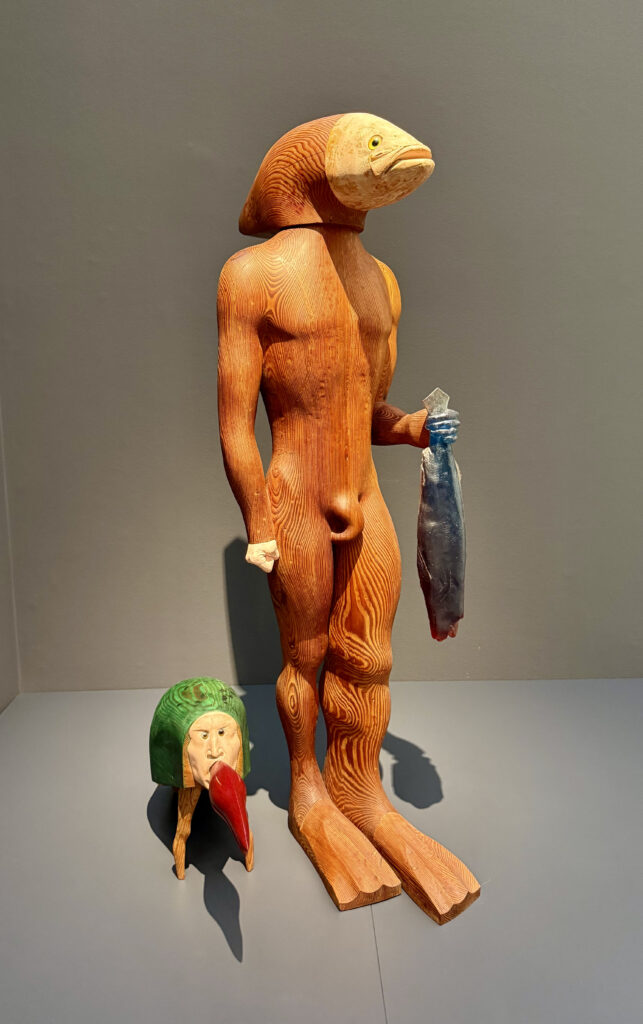
This was radically different from the world she had inhabited in New York: galleries, collectors, celebrities, Pop Art and the increasingly commercial art scene.
In the 1970s, Marisol’s practice underwent another significant transformation. She increasingly turned towards animal subjects, particularly marine creatures such as sharks, barracudas, and fish.
The shift from human to animal does not represent an abandonment of her earlier concerns. Rather, it extends her investigation of embodiment.
Animals become alternative forms through which to examine aggression, vulnerability, identity, and physical presence. In some works, her own face is incorporated into the animal body, producing an unsetting collapse between human and non-human identity.
Underwater, she discovered another world.
The fish became a way of representing freedom, movement, and a form of existence completely outside human society.
And this is particularly significant to Marisol because, through her career, she had been preoccupied with identity, the human body, and the pressure of social roles.
Her early sculptures often represented people almost frozen social characters- families, celebrities, politicians, wealthy society figures.
The fish are almost the opposite.
They have no social identity.
They don’t pose for society.
They don’t perform a role.
They don’t speak.
They simply move.
So, when she went under water, the experience can be understood as a kind of escape from the human world- a world that had always been complicated for her.
Her fish sculptures consequently feel much more sensual and liberated than many of her earlier, rather rigid human figures.
She carved sharks, barracudas, needlefish, parrotfish, and other marine creatures, often in beautifully worked mahogany, frequently incorporating her own face into the animals. The fish are Marisol herself. So, the sculpture becomes a strange self-portrait. This is why I would be careful about describing the fish simply as an interest in marine biology or an exotic Tahitian subject. They represent something much deeper: a transformation of identity.
There is also a beautiful linguistic coincidence; her mother called her as Marisol, associating it with the Spanish words for sea and sun.
That makes Tahiti works particularly poetic: after years of making sculptures about people ant the masks they wear, Marisol turned toward a world beneath the surface, where she could imagine an identity that was fluid, silent and free.
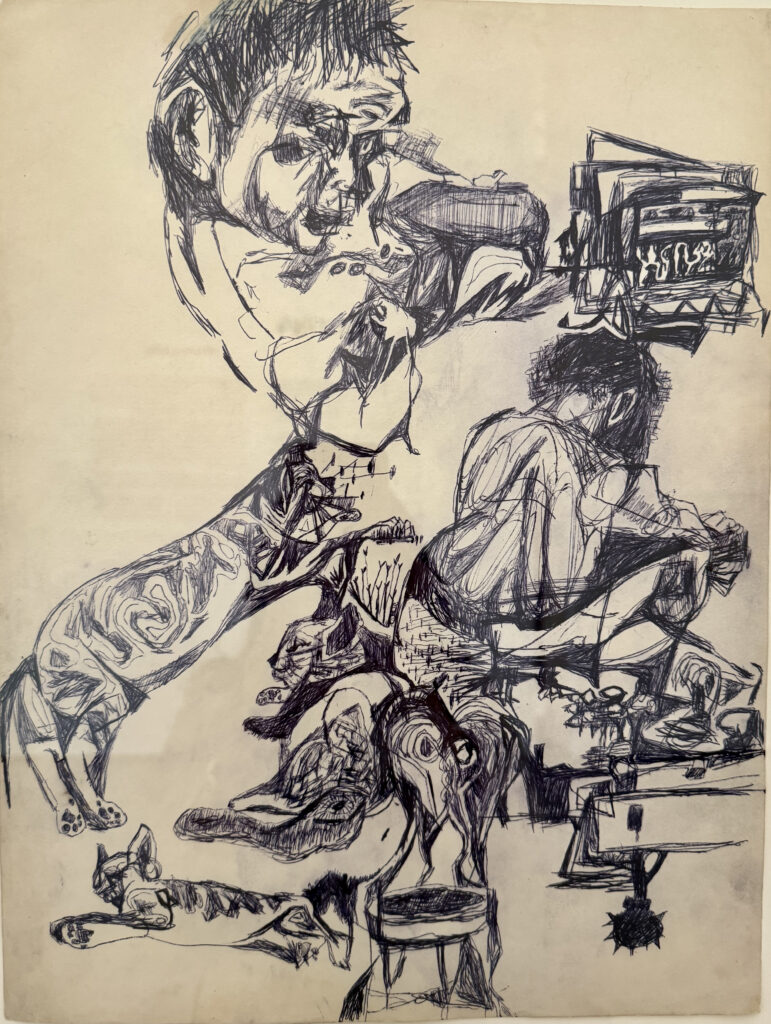
Perhaps the most moving way to understand Marisol’s final years is not as a period of decline, but as a profound stripping away. The theatricality of her early sculptures, the social masks of the 60s, the liberation of the marine world and the introspection of her later portraits gradually gave way to something more elemental: memory, gesture, and the simple act of making.
Her late drawings, created even Alzheimer’s disease affected her ability to communicate, acquire an almost existential force. The hand continues to draw when language begins to disappear. In this sense, Marisol’s art remained what it had always been -a form of communication, a way of reaching the world when words were insufficient.
Marisol died in Manhattan in 2016, at the age of eighty -five, leaving behind an oeuvre that resists every easy classification. Marisol spent her life constructing identities only to question them again. And ultimately, her greatest subject may have been this elusive space between presence and disappearance- the self we reveal to the world, and the self that remains forever beneath the surface.
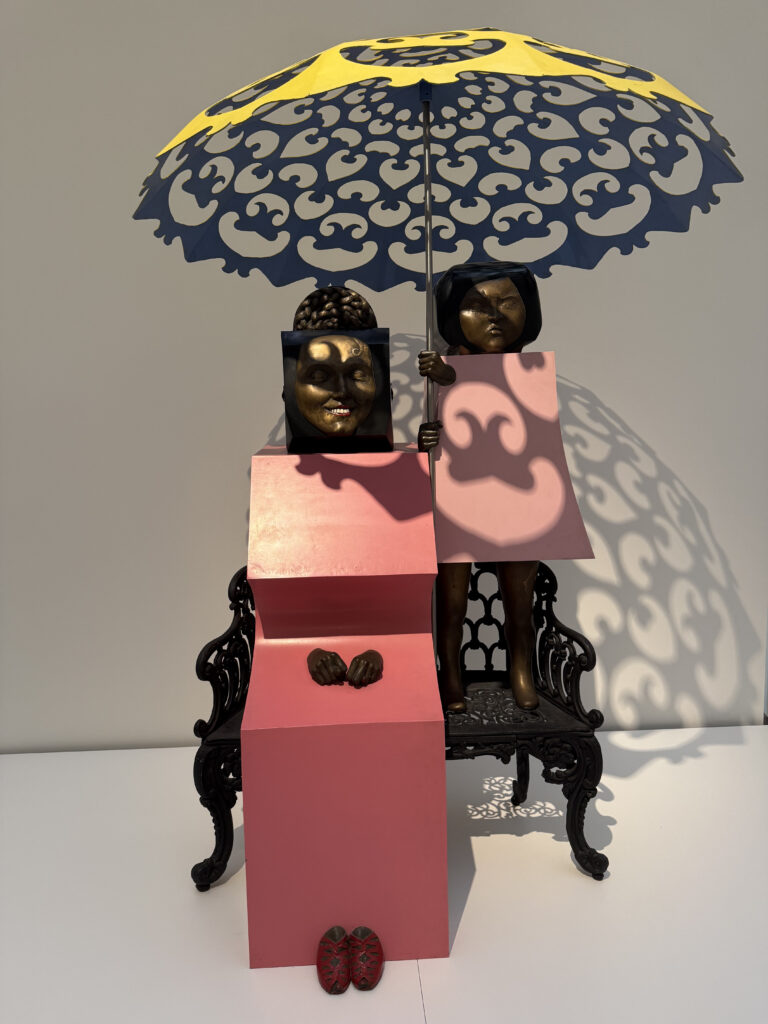
The exhibition, today at Kunsthaus Zurich, her first major retrospective in Europe, makes visible her extraordinary career spanning five decades.
Leaving the exhibition, one is left with feeling that Marisol never revealed herself- she transformed herself, again and again, into figures, animals, icons, and fragments of memory. Perhaps this is the enduring magic of Marisol: the mor closely we look at her, the more mysterious she becomes.

